Your AI rollout is one governance skip away from becoming your next CRM disaster.
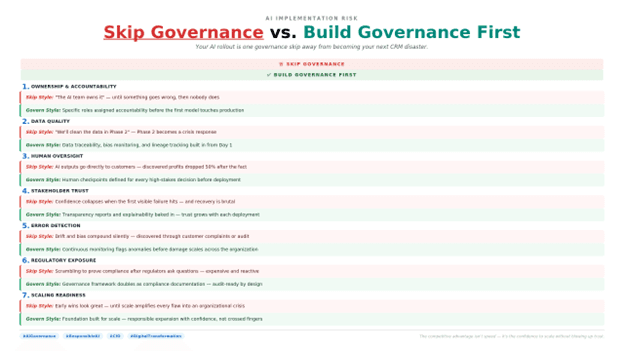

I've sat in the crisis room when a CRM implementation imploded. Customers locked out of services they paid for. Invoices wrong. Stakeholders furious. Budget blown. The team exhausted and pointing fingers.
It wasn't a technology failure.
It was a governance failure that technology made visible.
We're about to replay that same movie — at scale — with AI. And the plot twist is that most leaders don't see it coming, because AI works beautifully in the demo.
Here's what the CRM crisis and an ungoverned AI rollout have in common:
Nobody asked the hard questions before go-live.
Who owns the outputs when something goes wrong?
What data is this actually trained on — and did stakeholders get involved early and check it?
When the system makes a bad call, who's accountable?
How will we know it's drifting before the damage is done?
In the CRM world, we called those "Phase 2 problems." They weren't. They were Day 1 requirements the technology 'champion' deferred until they became emergencies.
What responsible AI governance actually looks like before you scale:
It's not a compliance checklist. It's a set of decisions your organization has to make — and own — before the system touches a customer, a hiring decision, or a financial transaction.
Clear business process ownership assigned to specific roles, not vague teams
Data traceability so you know what the AI learned and from where
Human checkpoints before high-stakes outputs go anywhere
Transparent documentation of what the model can and cannot do
A feedback loop that catches errors before they compound
None of this is glamorous. It's exactly the kind of foundational work that gets skipped when everyone's excited about the capability.
The vending machine problem
A company deployed AI to manage inventory for their vending machines. Smart idea. No human oversight built in. Profits dropped 50% before anyone noticed the system was making consistently bad stocking decisions.
That's a vending machine. Now imagine that same dynamic applied to customer pricing, loan approvals, or clinical recommendations.
The technology didn't fail. The governance did.
The leaders who will win with AI aren't the fastest movers.
They're the ones who treated risk and responsibility as a foundation, not a feature. Who asked "who's accountable when this is wrong?" before "how fast can we deploy?"
The CRM recovery roadmap is painful, expensive, and entirely avoidable. The AI version of that crisis will be orders of magnitude harder to unwind.
Build the governance framework first. The competitive advantage isn't speed — it's the confidence to scale without blowing up trust.